Yard Regrading and Swale Construction in Chandler, AZ
Yard regrading and swale construction in Chandler, AZ to move water off your lot and away from the foundation across caliche and clay soils.
When water sits where it should run off
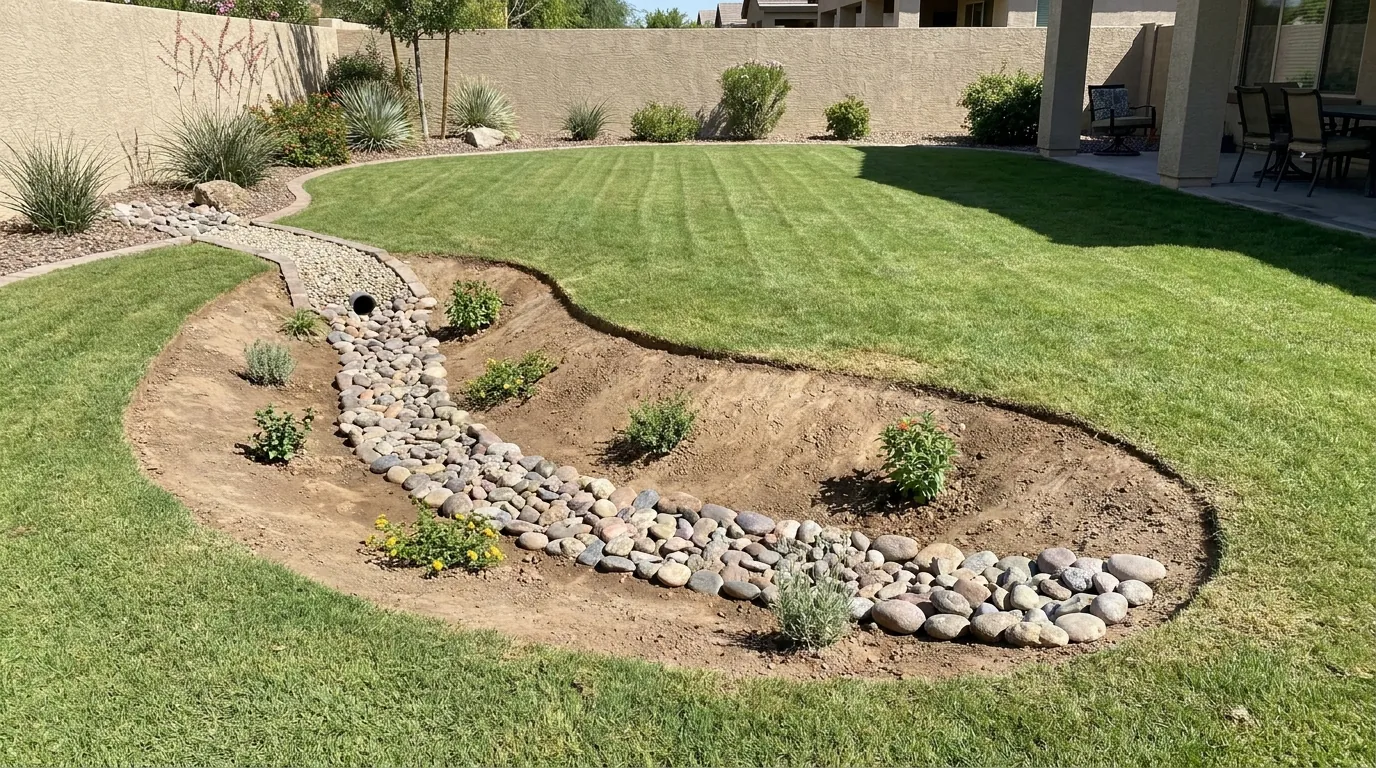
Most drainage problems in Chandler start with the shape of the ground, not the pipe. If your lot was graded flat during construction, or settled unevenly over the compacted subsoil common here, rainwater has nowhere to go. It ponds against the slab, collects in low spots in the lawn, and sits for days because the caliche and clay underneath barely absorb it. Regrading changes the slope of the surface so water is carried off by gravity, and a swale is the shallow, planted channel that gives that water a defined path to follow.
Warning signs that grading is the root issue include puddles that return in the same places after every storm, mulch and gravel washed into one corner of the yard, soil pulling away from the foundation, and water stains along the base of exterior walls. Where the low spot sits right next to the house, correcting the slope protects the foundation — a goal shared with our downspout extension and buried drain lines work, which handles roof water that grading alone cannot.
Regrading and swales are often the first thing we look at because they are the least mechanical and the most durable solution. When the surface is shaped correctly, you may need less buried pipe overall, which keeps the whole project simpler.
What the work involves
Every lot is different, but a regrading and swale project generally follows these stages.
-
Survey the fall
We shoot elevations across the problem area to find the actual high and low points and confirm where water can legally and safely exit — the property line, a street, or an alley. In flat Chandler yards the available fall is often only an inch or two, so measuring it precisely matters.
-
Plan the drainage path
We map the route the water should take and decide whether a broad surface swale, a reshaped lawn slope, or a combination moves it best. The target is a continuous downhill path with no low points that trap water along the way.
-
Cut, fill and compact
Soil is removed from high spots and added to low ones, then compacted so the new grade holds. Caliche layers near the surface are broken up or worked around; this hard calcium-carbonate hardpan is why some Chandler yards need machine work rather than a simple reshape.
-
Shape and stabilize the swale
The channel is formed with a gentle, even slope and finished with turf, rock, or a vegetated bottom so it carries water without eroding. A swale should look like part of the landscape, not a ditch.
-
Confirm the outlet and test
We verify the water reaches its intended exit and, where possible, run water across the finished grade to check that nothing ponds before the project is considered complete.
How Chandler soil and monsoons change the job
Chandler's arid heat, caliche, and heavy monsoon downpours make surface grading more important here than in wetter climates with absorbent soil. Our ground does not percolate well — a single August storm can drop more water in an hour than the clay subsoil will take in a day — so that water has to be moved across the surface or into engineered drainage rather than counted on to soak away.
Caliche also complicates the digging. Where a hard hardpan layer sits close to the surface, cutting a swale or lowering a grade can require heavier equipment and more spoil removal. On the other hand, that same hardpan means a well-shaped swale stays put once it is built, because the compacted base resists erosion.
Because water that is only redirected at the surface still has to go somewhere, swales are frequently paired with a dry well and pop-up emitter at the low end, or tied into catch basins, so the collected flow has a controlled discharge instead of dumping onto a neighbor's lot.
Find out if grading is your real problem
We can walk your yard, read the slope, and tell you whether regrading, a swale, buried drainage, or a combination will keep water away from your home.
Serving Chandler and nearby East Valley communities.
Frequently asked questions
Will regrading alone fix my drainage, or do I still need pipe?
It depends on where the water comes from and where it can exit. Surface grading handles sheet flow and ponding in open yard, but concentrated sources like downspouts or a trapped low spot with no outlet usually still need buried drainage. We assess both before recommending a plan.
How much slope does a swale need in a flat Chandler yard?
A swale needs continuous downhill fall to carry water, and in flat local lots the available drop can be very small. We measure the actual elevations first, because a swale built without real fall simply becomes another place water collects.
Can you regrade without killing my existing landscaping?
Often the work can be routed to protect established plants and turf, and swales can be finished with grass or rock to blend in. Significant grade changes near the house may still disturb some plantings, which we flag before starting.
Will the new grade hold up through monsoon season?
Properly compacted fill and a stabilized swale bottom are built to withstand monsoon flows. The finish — turf, rock, or vegetation — is chosen to resist erosion at the volumes your yard sees.