Serving Chandler, AZ Call us: (520) 391-5581

Where hard surfaces send water the wrong way

Driveways and window wells are two of the most common places water ends up where it is not wanted. A driveway is a large, hard, impermeable surface, and when it slopes toward the garage or house, every storm sheets that water straight at the building. Window wells, meanwhile, are below-grade pockets that collect runoff and, if they do not drain, hold standing water against the window and the wall behind it.

Warning signs include water creeping under the garage door after a downpour, a wet apron where the driveway meets the slab, mineral staining on garage walls, and a window well that holds water or mud long after a storm. Left alone, these lead to interior water intrusion, damaged door seals, and seepage around below-grade windows.

The fix is usually a point solution that intercepts water before it reaches the opening. For driveways that often means a trench or channel drain across the low edge; for window wells it means a drain at the base connected to a path that carries water away. Both commonly tie into the same buried network used for downspout extensions and buried drain lines.
What we install

The right component depends on where the water concentrates and where it can be routed to exit.

Driveway channel (trench) drains

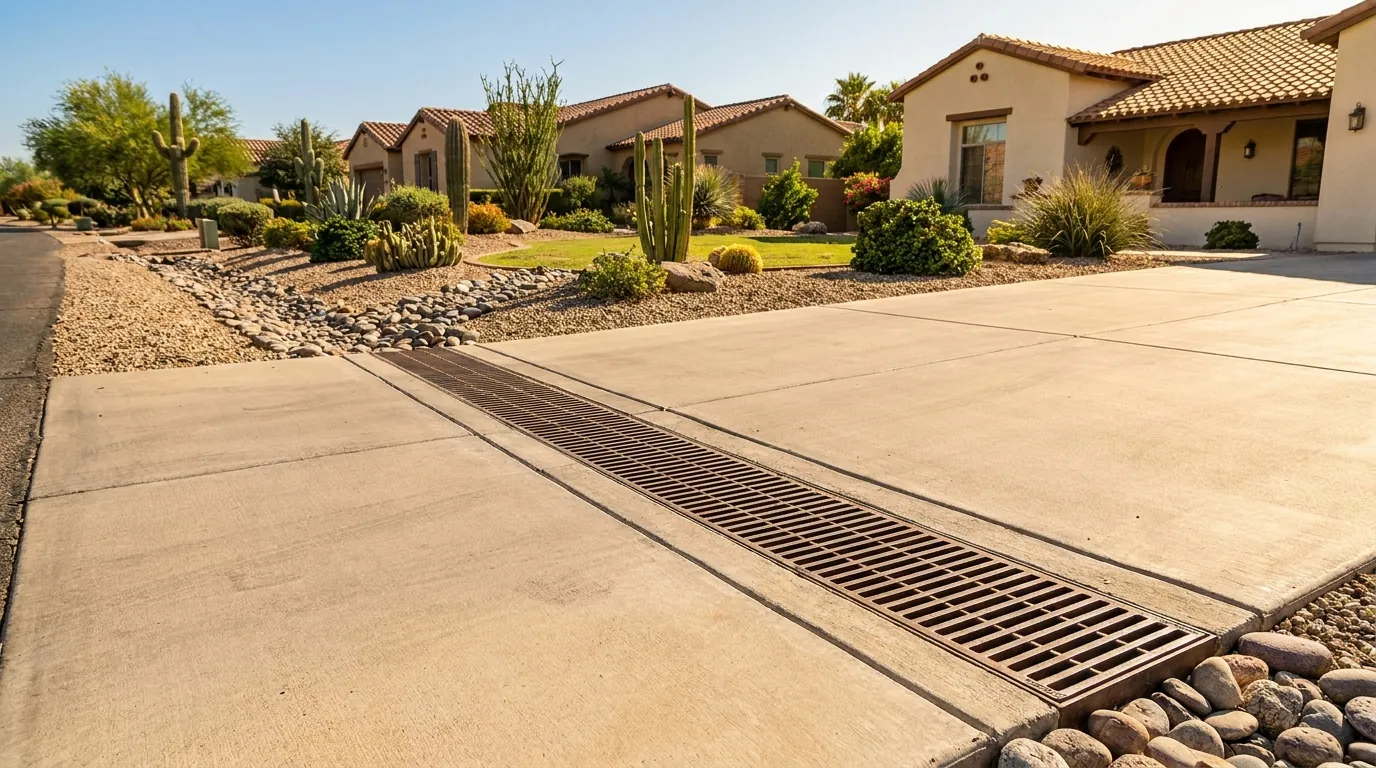
A linear grate set flush across the driveway catches sheet flow before it reaches the garage and pipes it to a safe outlet. The grate and frame are sized for vehicle traffic, and the channel is set with enough fall to clear fast monsoon volumes.

Garage apron and threshold protection

Where water pools at the garage threshold, we intercept it with drainage set along the apron so runoff never reaches the door seal, rather than relying on the seal to hold back standing water.

Window well drains

A drain is installed at the base of the well and connected to a buried line or a dry well so water cannot accumulate against the glass and frame. Well liners and gravel bases are added where they help the water reach the drain.

Outlet routing

Every point drain needs somewhere to go. We route collected water to daylight, a catch basin, or a dry well so the problem is moved off the structure entirely, not just relocated a few feet away.

Chandler conditions that make these problems worse

Chandler gets little rain for most of the year, then monsoon storms deliver a large volume in a very short window. Hard surfaces like driveways shed nearly all of that water instantly, so the peak flow a channel drain has to handle is high even though total annual rainfall is low. Undersized or poorly sloped drains overflow in exactly the storms that matter.

The caliche and compacted subsoil under local properties mean water that does get into a window well will not simply soak away — it sits. That standing water is why a connected drain, rather than a gravel bottom alone, is usually necessary here. The same hardpan can make trenching for the outlet line slower, which is worth knowing when planning the route.

Because driveway and window well drains are small catchments feeding a shared outlet, they are often installed alongside yard regrading and swale construction so the whole lot drains to one coordinated system instead of a patchwork of disconnected fixes.

Stop runoff before it reaches the house

If water sheets toward your garage or collects in a window well, we can design a drain that intercepts it and routes it to a safe outlet.

Serving Chandler and the surrounding East Valley.

Frequently asked questions

Can a channel drain handle a full monsoon downpour?

A correctly sized and sloped channel drain is designed for the peak flow off your driveway, which is what matters during a monsoon burst. Capacity depends on driveway area and slope, so we size the grate and channel to the water it actually has to carry.

My window well fills with water every storm — why?

Most window wells in Chandler have no working drain, and the clay and caliche below will not let the water soak away. A drain at the base connected to a buried line or dry well removes the water instead of letting it pond against the glass.

Will cutting into my driveway for a drain weaken it?

A channel drain is set into a formed slot with proper frame support, so the surrounding concrete stays sound and the grate carries vehicle loads. We plan the cut so the driveway remains structurally intact.

Can driveway and window well drains connect to my other drainage?

Yes. These point drains usually tie into the same buried network as downspouts and yard drains, routing to a single outlet or dry well. Combining them keeps the system simpler and avoids multiple discharge points.