Dry Well and Pop-Up Emitter Installation in Chandler, AZ
Dry well and pop-up emitter installation in Chandler, AZ to give collected runoff a controlled, safe discharge in caliche and clay soil.
What to do when water has nowhere to exit
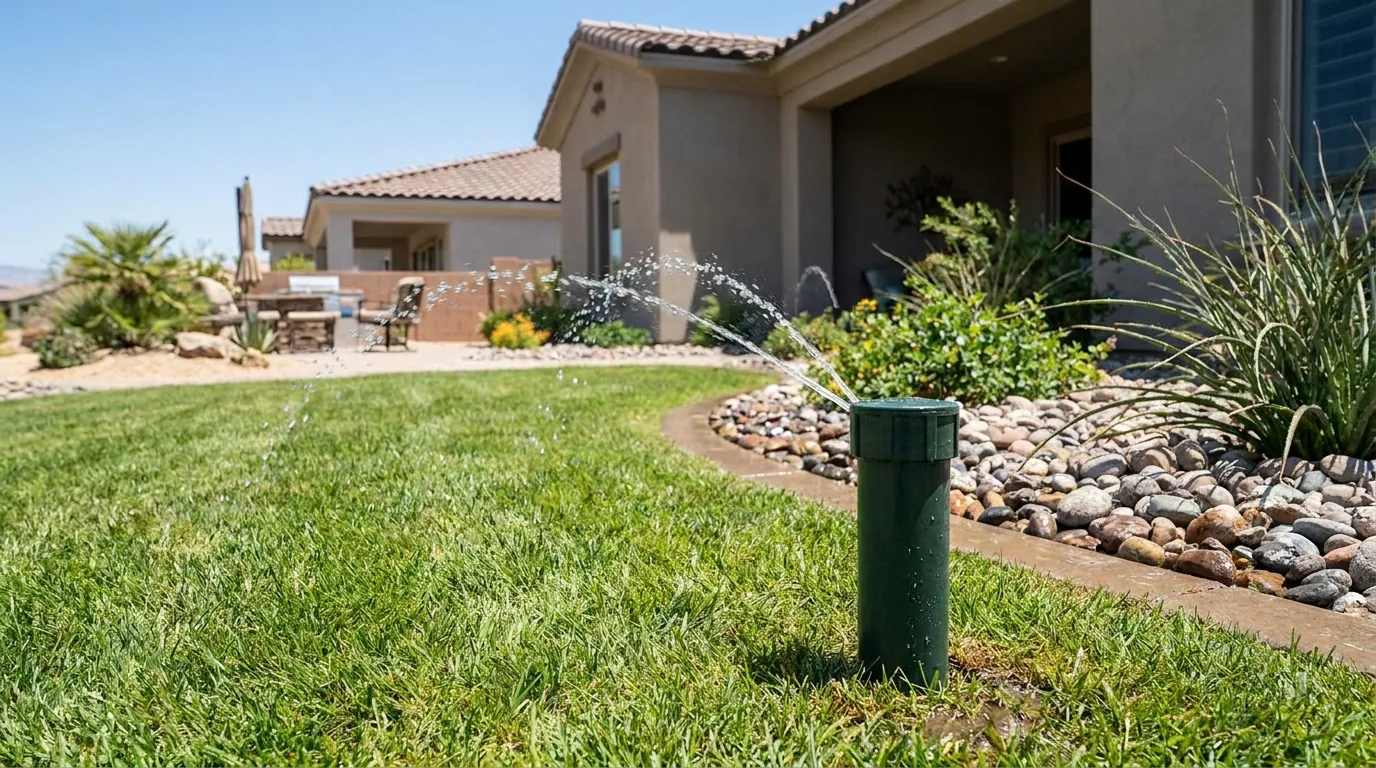
Every drainage system eventually has to put water somewhere. In Chandler, where lots are flat and there is often no slope to carry water to a street or alley, the discharge end is frequently the hardest part of the job. A dry well is a buried storage chamber that holds collected runoff and releases it slowly into the surrounding soil. A pop-up emitter is a small grate at the surface that opens under water pressure to release flow at a safe spot, then closes flush with the lawn.
You may need one of these if your drains, downspout lines, or swale all converge with no downhill exit — a common situation signaled by water backing up in a catch basin, a buried line that never seems to empty, or a low corner that stays soggy because there is nowhere for the collected water to drain to. These components are what make the rest of a system work; they are the destination for pipe from a French drain installation or a network of catch basins.
Choosing between a dry well, a pop-up emitter, or a direct outlet to daylight depends on how much water arrives, how fast, and what the soil can accept — which in Chandler is the central challenge.
How the installation works
A dry well or emitter is sized and placed based on the volume feeding it and the soil's ability to absorb water.
-
Estimate the inflow
We calculate how much water the connected drains deliver during a peak storm, since that volume determines the size of a dry well and whether an emitter alone is enough.
-
Test what the soil will take
Because Chandler's caliche and clay drain slowly, we evaluate how fast water will leave a dry well at the chosen location. Poor percolation means a larger chamber, a deeper placement below the hardpan, or an above-ground emitter instead.
-
Excavate and set the chamber
The dry well is dug, often through caliche, and set on a bed of drainage rock wrapped in fabric to keep fine soil from clogging it. Depth and backfill are chosen so water can seep outward over time.
-
Connect the lines and emitter
Buried drain lines are tied in with the right fall, and where a pop-up emitter is used, it is placed at the lowest safe discharge point so it opens under flow and seals shut between storms.
-
Test the discharge
We run water through the system to confirm the dry well accepts it and the emitter opens and drains as intended before closing up.
Why Chandler soil decides the design
A dry well only works if the surrounding soil can absorb the water it stores. Chandler's heavy clay and caliche are exactly the conditions that make dry wells tricky — the ground percolates slowly, so an undersized well fills during a monsoon and overflows. That is why sizing and a realistic look at local soil matter more here than in sandy regions where almost any dry well drains freely.
Where percolation is too poor to rely on a dry well, a pop-up emitter that releases water to the surface at a safe low point can be the better answer, letting the water sheet away rather than depending on it to soak in. In many yards the right solution is a combination: a dry well for routine storms with an emitter as an overflow path for the heaviest monsoon bursts.
These outlets are rarely installed on their own. They are the final piece of a system that usually starts with yard regrading and swale construction or buried collection lines, so the whole project needs to be planned together to make sure the discharge end can keep up with everything feeding it.
Give your drainage somewhere to go
If your yard collects water but has no natural exit, we can assess the soil and design a dry well, an emitter, or a combination that handles Chandler's storms.
Serving Chandler and nearby East Valley towns.
Frequently asked questions
Will a dry well actually work in Chandler's clay and caliche?
It can, but only if it is sized for the slow percolation of local soil and placed where water can seep outward. In poorly draining spots a larger chamber, deeper placement, or a pop-up emitter overflow is used so the system does not back up during a monsoon.
What is the difference between a dry well and a pop-up emitter?
A dry well is a buried chamber that stores water and lets it soak into the ground over time. A pop-up emitter is a surface grate that opens under water pressure to release flow at a safe spot. Yards with poor absorption often use an emitter, and some use both.
How do I know if I need one of these?
If your drains, downspout lines, or swale all collect water but there is no downhill exit to a street or alley, the system needs a discharge point. Water backing up in a catch basin or a line that never empties are common signs the outlet is missing or undersized.
Will a pop-up emitter leave something ugly in my lawn?
The emitter sits flush with the grade and only opens when water is flowing, then closes again, so it is barely visible between storms. We place it at the lowest safe point so it blends into the landscape.