French Drain Design and Installation in Chandler, AZ
French drain design and installation in Chandler, AZ. How a buried gravel-and-pipe drain moves water off clay and caliche lots and away from your foundation.
When a french drain is the right fix
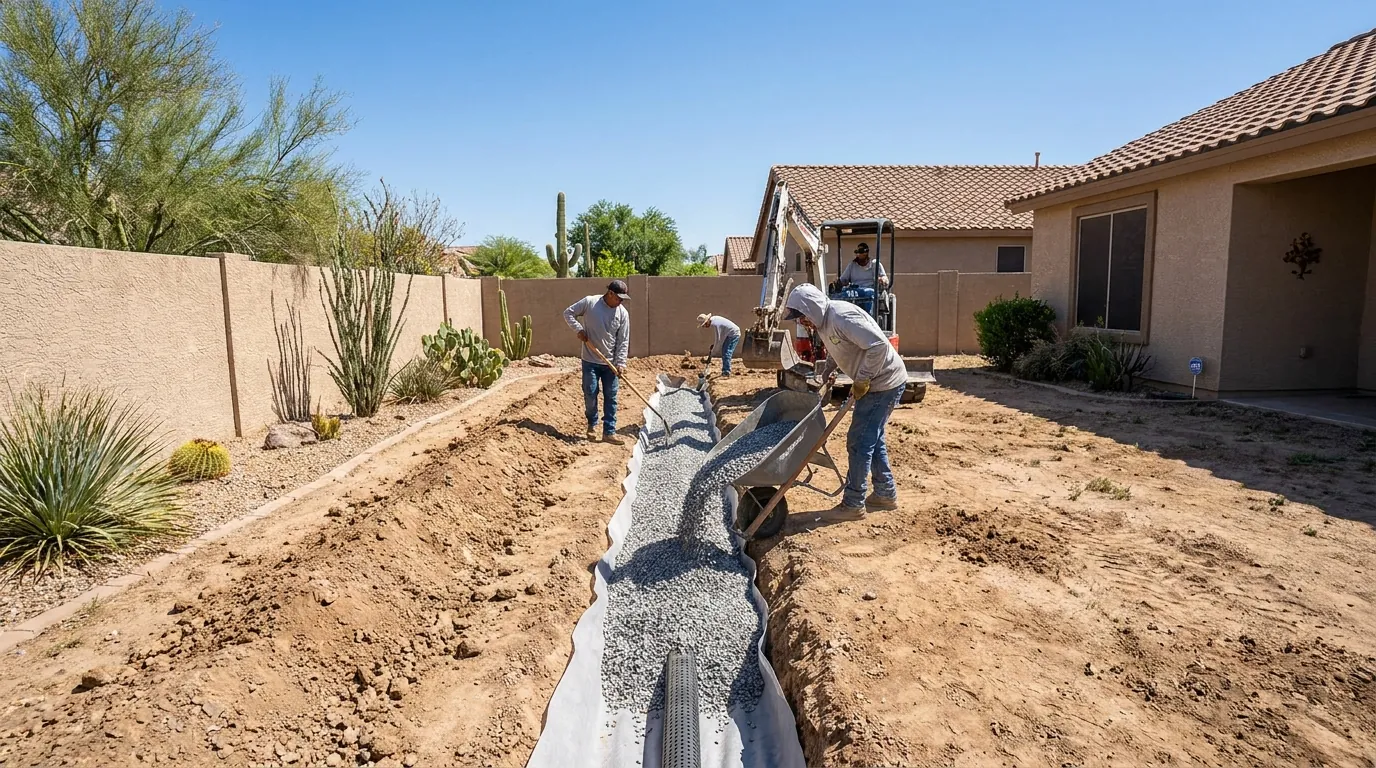
If part of your Chandler yard stays soggy for days after a monsoon storm, or water sheets toward the house every time it rains, the ground is telling you it cannot move water fast enough on its own. A french drain is a buried trench lined with filter fabric, filled with washed gravel, and built around a perforated pipe. Water that collects in the soil or pools on the surface drains into the gravel, enters the pipe through its slots, and travels downhill to a point where it can safely leave — a street, a dry well, or a pop-up emitter in a lower part of the lot.
The reason this matters so much in Chandler is the soil. Much of the area sits on heavy clay over a hardpan layer of caliche — a cemented, nearly impermeable crust. Rain that would soak away in sandy ground instead perches at the surface or inside the top foot of soil and runs sideways. On flat residential lots, that sideways movement has nowhere good to go, so it collects at low spots and against foundations. A french drain gives that trapped water an engineered path out.
French drain installation is usually part of a larger plan. Many Chandler yards also need surface catch basins and area drains to grab water from paved low points, or downspout extension and buried drain lines to keep roof runoff out of the trench in the first place.
What a french drain installation involves
Every lot is different, but a sound installation follows the same sequence.
-
Find the water and the outlet
The first job is figuring out where water collects and — just as important — where it can legally and physically go. On a flat Chandler lot the outlet often decides the whole design, because a drain with nowhere to empty just moves the puddle underground.
-
Set the fall and the trench line
The trench is dug to maintain a steady downhill slope so water keeps moving. Through caliche this can mean breaking or cutting the hardpan, which is slower and heavier work than digging in soft soil and affects both time and cost.
-
Line, bed and lay the pipe
Filter fabric lines the trench to keep fine clay from clogging the gravel. Washed rock beds the perforated pipe, which is set slot-side as the design calls for so soil water enters while sediment stays out.
-
Backfill and restore
More washed gravel surrounds the pipe, the fabric is wrapped over the top, and the trench is finished with gravel at the surface or capped with soil and sod depending on where it runs. The outlet is set so it drains freely and stays clear.
Get a drainage plan for your lot
Tell us where the water sits and we will walk the yard, find the fall, and lay out a system that actually drains it.
Serving Chandler and nearby East Valley communities.
Frequently asked questions
How much does french drain installation cost in Chandler?
Cost depends on trench length, depth, how much caliche has to be cut, and where the outlet is. A short run along one soggy side yard costs far less than a system that ties in downspouts and crosses a full back yard. We price each job after seeing the fall and the outlet.
How deep does a french drain need to be?
Depth is set by where the water is and where it has to go, not by a fixed number. A drain intercepting surface runoff can be shallow, while one pulling water away from a foundation usually goes deeper. The pipe must still keep a continuous downhill slope the whole way.
Will a french drain work in clay and caliche soil?
Yes — in fact clay and caliche are the reason most Chandler yards need one. Because the soil will not absorb water quickly, the drain's job is to collect it and carry it to an outlet rather than relying on the ground to soak it up.
How long does an installation take?
A single straightforward run can often be done in a day or two. Longer systems, hard caliche, and jobs that combine a french drain with regrading or catch basins take longer. We give a realistic timeline once the design is set.