Yard Drainage French Drain Repair in Chandler
French drain repair in Chandler, AZ: fixing clogged, collapsed, or crushed yard drains that fail during monsoon storms on caliche soil.
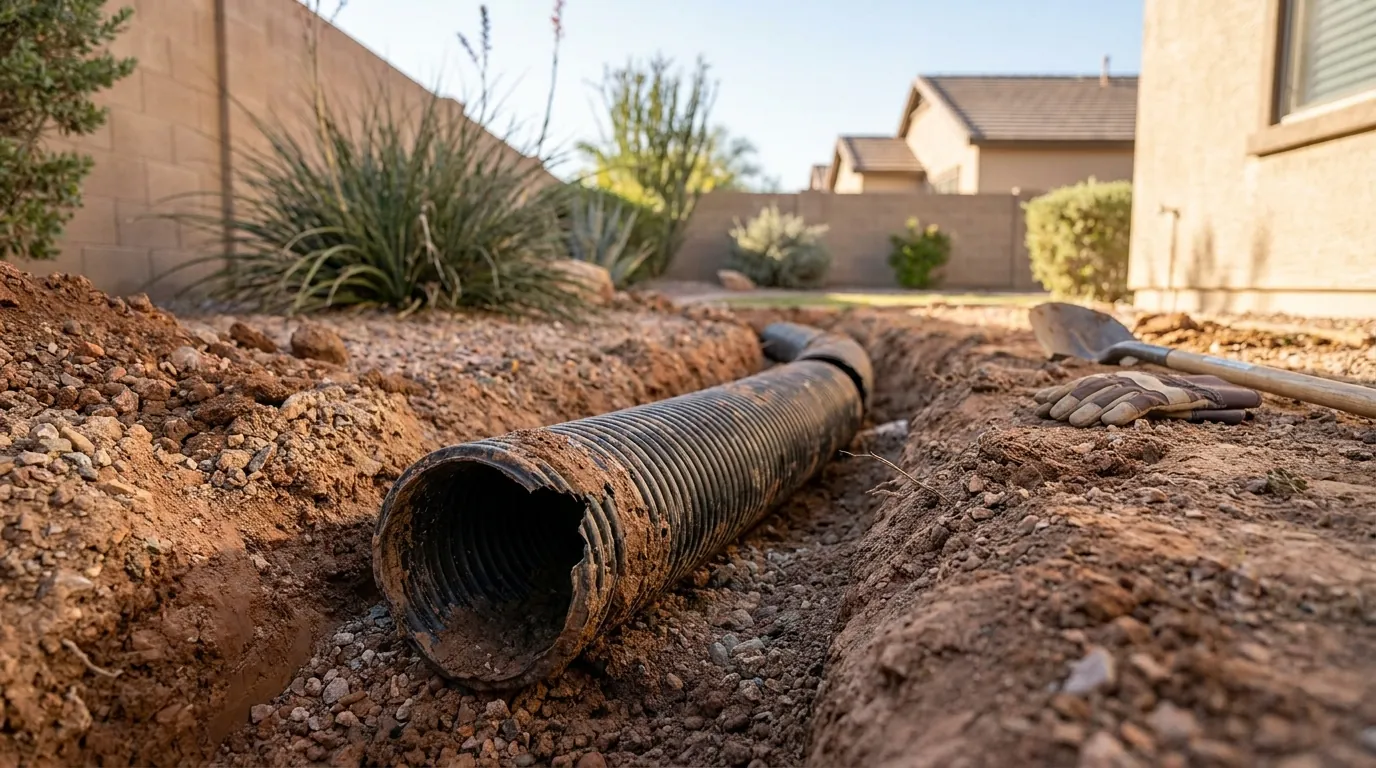
Signs your french drain has failed
A french drain can look fine at the surface while it has stopped working underground. The warning signs usually show up during or right after rain. Water pools in the same low spot even though a drain is buried nearby. The ground over the drain line stays soggy long after the rest of the yard has dried. An outlet that used to run during storms now trickles or stays dry, meaning the water is stuck somewhere between the inlet and the exit. In the worst cases, water reappears against a foundation or under a patio slab — the exact places the drain was built to protect.
Repair addresses a system that is broken, not just dirty. Common failures in Chandler yards include a crushed or collapsed pipe under a driveway or paver patio, roots that have grown into and choked the line, fabric that has clogged solid with silt, a separated joint that dumps water into the soil, and a buried or damaged outlet. Each of these needs the line opened, diagnosed, and corrected rather than simply flushed.
If the drain is intact but slow, a french drain service visit may be all you need. If the system is fundamentally too small or poorly routed for the water it faces, replacement through french drain installation is often more cost-effective than repeatedly patching it.
How a repair is carried out
Repair follows the water. The goal is to find where flow stops, fix that point, and confirm the whole line works again.
-
Locate the failure
We trace the drain from inlet to outlet and use flow testing to narrow down where water is stopping. A drain that fills at the inlet but never reaches the outlet points to a clog or collapse somewhere in between.
-
Excavate the affected section
Only the failed portion is dug up when possible, which keeps the repair contained. In Chandler this often means cutting through hardpan caliche, so the excavation is slower and more deliberate than in soft soil.
-
Repair or replace the pipe and bedding
Crushed pipe is replaced, separated joints are reconnected, and silted or torn filter fabric and gravel are swapped for clean material. If roots caused the failure, the routing may be adjusted to move the line away from them.
-
Restore the outlet and grade
The outlet is cleared or rebuilt so water leaves the system freely, and the surface grade above the drain is reset to steer runoff back toward the inlet. The line is flow-tested again before backfilling.
Why Chandler conditions cause specific failures
The same conditions that make french drains necessary in Chandler also make them fail in predictable ways. Caliche sheds water instead of absorbing it, so all the runoff a storm produces is concentrated at the drain. During a monsoon burst, an undersized or partly clogged line is overwhelmed in minutes, and the pressure of that surge can push apart weak joints or blow silt into a tighter and tighter plug.
Heat and dryness work against buried systems too. Long dry spells let fine silt and decomposed granite accumulate inside pipe and fabric, and the ground shifts as it dries and then swells with sudden moisture. That movement stresses pipe joints and can crack rigid fittings over time. Tree roots, meanwhile, are drawn to the one reliably moist zone in an otherwise arid yard — the drain itself — and grow straight into it.
Because caliche makes excavation harder, a proper diagnosis matters before any digging starts. Opening the right three feet of line beats trenching the whole yard. That is the difference between a targeted repair and an expensive guess.
Get a failing drain diagnosed
If your drain backs up, stays soggy, or lets water reach places it should be keeping dry, reach out to have the system diagnosed and repaired.
Serving Chandler and nearby Gilbert, Tempe, Mesa, Queen Creek, Casa Blanca, and Sacaton.
Frequently asked questions
Is it worth repairing an old french drain or should I replace it?
It depends on why it failed. A single crushed section or a buried outlet is usually worth repairing. A drain that is undersized for the water it faces, or that clogs again shortly after every cleaning, is often better replaced with a properly sized new installation.
How do you find the clog without digging up the whole yard?
We trace the line from inlet to outlet and use flow testing to find where water stops moving. That narrows the problem to a specific stretch, so excavation is limited to the failed section rather than the entire run.
Why do roots keep getting into my drain?
In an arid yard, a french drain concentrates the only steady moisture around, so nearby tree and shrub roots grow toward it. Repair can clear the roots and, where possible, reroute or shield the line to reduce how quickly they return.
My drain worked for years and suddenly backs up — what changed?
Often the outlet has become blocked or the line has slowly silted up until a heavy monsoon finally overwhelms it. Sometimes new landscaping or hardscape has crushed a section or redirected runoff. A diagnosis identifies which of these is at play.